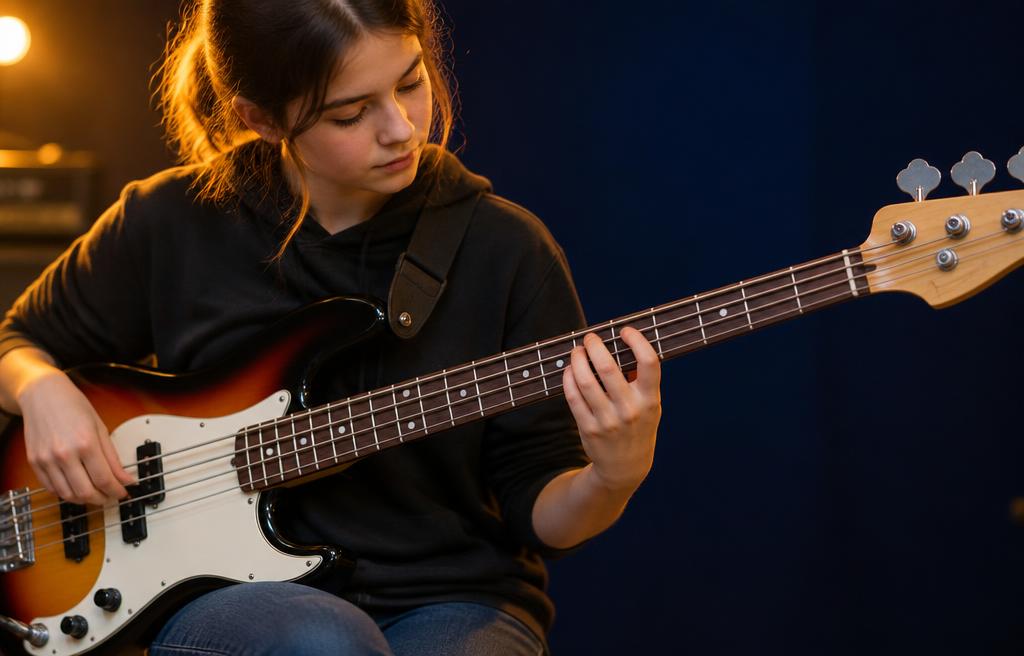
You'll tune to standard E A D G, learn to pluck evenly with two fingers, find your first notes on the E and A strings, and play root notes in time — the skill most songs need from a bass player.
Getting started
What you need
A four-string electric bass, a small practice amp or headphone amp, a cable and a tuner. A free tuner app works fine.
How to tune a bass guitar
From the thickest to the thinnest string, standard tuning is E A D G — the same notes as a guitar's four lowest strings, one octave lower. Tune up to each note with a tuner.
Plucking technique
Rest your thumb on a pickup and alternate your index and middle fingers. Aim for every note to sound equally loud before trying to play faster.
Your first bass grooves
Start by playing the root note of each chord on every beat with a metronome. Once that is steady, double it to eighth notes for a driving rock groove.
The beginner bass lessons
- 1Parts of the Bass GuitarGet to know the four-string bass and what each part does. 5 min • Beginner
- 2How to Hold the BassSit or stand with the bass balanced so neither hand has to hold it up. 5 min • Beginner
- 3How to Tune a BassStandard bass tuning is E A D G, from thickest to thinnest string. 6 min • Beginner
- 4Plucking with Your FingersAlternate your index and middle fingers to pluck evenly. 8 min • Beginner
- 5Your First Notes on the FretboardFind the notes on the E and A strings up to the 5th fret. 10 min • Beginner
- 6Playing Root Notes in TimePlay the root note of each chord on every beat — the core job of a bassist. 10 min • Easy
- 7Your First Bass GroovePlay an eighth-note root groove over G – Em – C – D. 12 min • Easy
A simple 15-minute practice routine
- Tune your bass (2 minutes).
- Alternate-finger plucking on open strings (3 minutes).
- Say and play the notes on the E and A strings up to fret 5 (5 minutes).
- Play root notes over G – Em – C – D with a metronome (5 minutes).
Jump to a lesson
- Learn the parts of the bass guitar →
- How to tune a bass →
- Bass plucking technique →
- Play root notes in time →
- Play your first bass groove →
Common questions about learning bass
Is bass guitar easier than guitar for beginners?
Bass usually means playing one note at a time instead of chords, which many beginners find easier at first. It still takes practice to develop steady timing and finger strength.
Do I need an amplifier to practise bass?
An unplugged electric bass is very quiet, so a small amp or headphone amp is recommended. It helps you hear your timing and tone clearly.
Should I play bass with fingers or a pick?
Both are valid. Fingers give a rounder tone and are the most common starting point; a pick gives a brighter attack. These lessons use fingers, but you can follow them with a pick.
What is the main job of a bass player?
To lock in with the drums and outline the chords, usually by playing root notes in steady time. That's why timing is the focus of the beginner lessons.