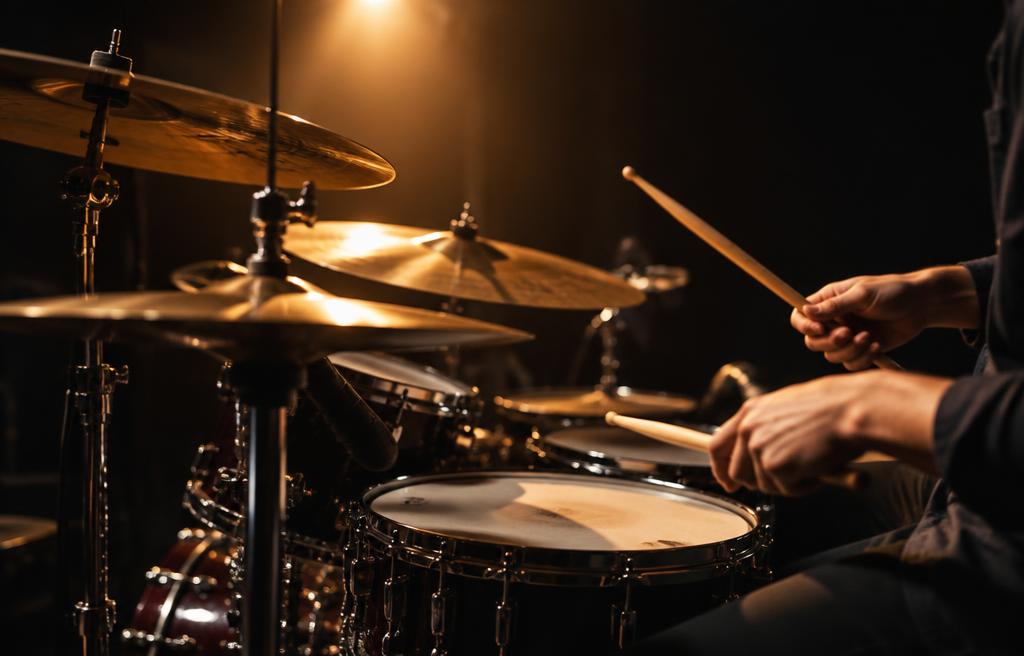
You'll learn the basic rock beat — hi-hat on every count, kick drum on 1 and 3, snare on 2 and 4 — then practise keeping time with a metronome and add a simple fill that leads back into the beat.
Getting started
What you need to start
An acoustic kit, an electronic kit or even a practice pad and a pair of sticks. A practice pad is a quiet, low-cost way to work on stick control and timing at home.
Parts of the drum kit
A standard kit has a kick (bass) drum, snare, hi-hat, toms and cymbals. The kick, snare and hi-hat do most of the work in beginner beats.
How to hold drumsticks
With matched grip both hands hold the sticks the same way. Pinch the stick about a third of the way up between your thumb and index finger, and let the other fingers wrap loosely so the stick can bounce.
Your first drum beat
Count “1 & 2 & 3 & 4 &”. Play the hi-hat on every count first, then add the snare on 2 and 4, and finally the kick on 1 and 3.
The beginner drums lessons
- 1Understanding the Drum KitLearn the pieces of a standard 5-piece kit and what each does. 5 min • Beginner
- 2Correct Sitting PositionSet throne height so your thighs are level or slightly downward. 5 min • Beginner
- 3Holding the SticksThe matched grip — both hands hold sticks the same way. 6 min • Beginner
- 4Your First BeatThe basic rock beat: hi-hat eighths, kick on 1 & 3, snare on 2 & 4. 10 min • Beginner
- 5Keeping TimeDrummers are timekeepers — practise with a metronome. 8 min • Easy
- 6Basic FillsA simple 4-beat fill down the toms back into the groove. 10 min • Easy
- 7Play Your First GrooveCombine the rock beat and a fill into a full 8-bar groove. 12 min • Easy
A simple 15-minute practice routine
- Warm up with single strokes on a pad or snare (3 minutes).
- Play quarter notes with a metronome at 60–70 BPM (4 minutes).
- Play the basic rock beat, one limb at a time (5 minutes).
- Add a one-bar fill every fourth bar (3 minutes).
Jump to a lesson
- Learn the parts of the drum kit →
- How to hold drumsticks →
- Learn a basic drum beat →
- Practise drum timing →
- Learn simple drum fills →
Common questions about learning drums
Can I learn drums at home?
Yes. A practice pad or electronic kit with headphones keeps the noise down, which makes daily practice realistic. Timing, rhythm and stick control can all be developed this way.
Do I need a full drum kit to start?
No. Many drummers begin with sticks and a practice pad to learn grip and timing, then move to a kit for coordination between hands and feet.
How do I keep better time?
Practise with a metronome at a slow tempo and count out loud. Being steady at a slow speed is more valuable than playing fast and unevenly.
What is a drum fill?
A fill is a short pattern that breaks from the main beat, often played on the toms, to lead into the next section. It usually ends with a crash cymbal on beat 1.